The fissure
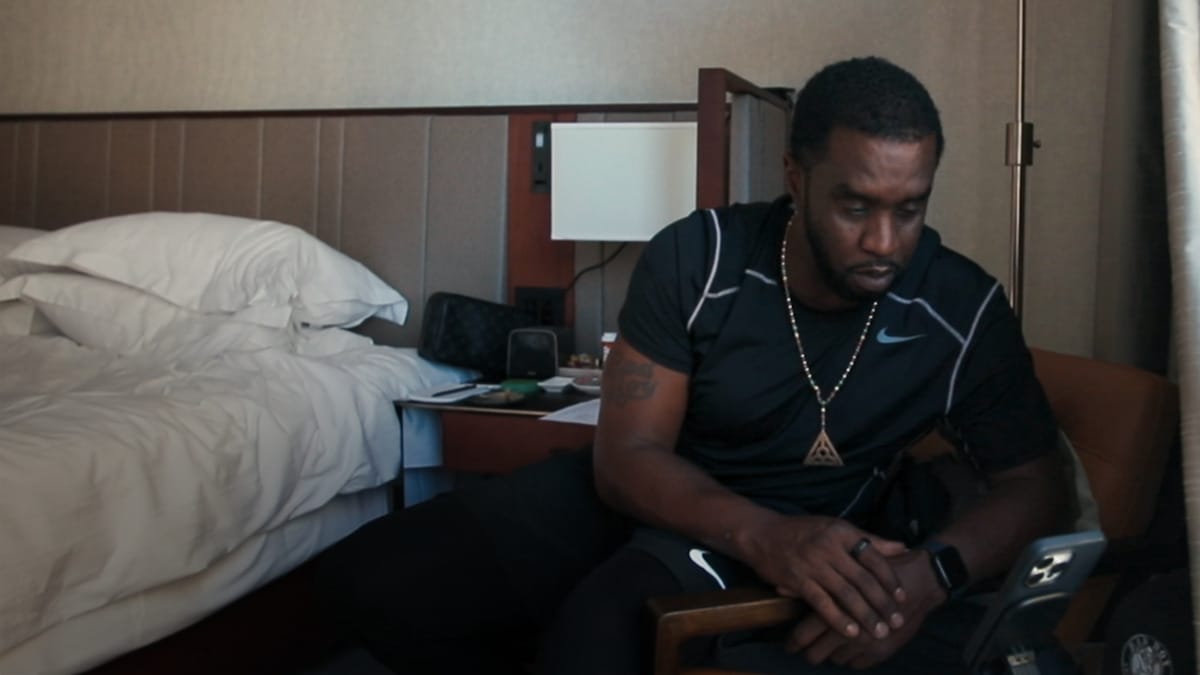
I watched Netflix's Diddy documentary and it's as well put together and terrifying as the reviews indicate. Meticulously, ruthlessly, methodically made to indict its subject. It's shocking that the production team scored so much footage from people so willing to speak, at length, about the harms Diddy caused.
Not perfect. It's subject to the sort of timeline rearrangement which is subtle enough to slip by but important enough the change the emphasis of the whole thing. But all documentaries, and I mean ALL, do that. Trust half of what you read and none of what you see, etc.
I want to focus on one thing here: the 1997 MTV Video Music Awards performance. If you're not familiar, Diddy did a special performance, with Sting and Faith Evans in tow, of his tribute to the Notorious B.I.G., which was charging up the charts in the wake of the latter's death.
I don't want to concentrate on the performance, itself, but on the 2025, post-documentary reactions to it. I first noticed it scrolling through TikTok (I have a now daily morning ritual of bed brainrot, proving that I'm exceedingly broken in the exact same way everyone else is). Nestled in comments under clips from the documentary were people saying some variation of "that VMA performance sure has a different feel now!"
And that's the problem.
I was alive in 1997, a fresh-faced 19/20 year old. And I remember being horrified by this performance at the time. In Sartre's Nausea, a man wakes up one morning to find himself unable to comprehend the world and people around him. This gives rise to the titular Nausea in him, a dizzy, slightly sweet sickness in him as his detachment grows.
Now, I think we all feel that sometimes. Sartre did, too, or else the book wouldn't have found much purchase. I think I feel that way a little more than other people, but I also think that I probably don't and that's me concocting some aloofness of my own (Antoine Roquentin isn't an entirely sympathetic protagonist). I am pretty certain that I remember those moments of feeling like an alien in the world acutely, at least the most acute instances.
One of those acute instances was in 1997, seeing the footage above. Because people were fawning over it. But it was so obviously tacky (to me, hence the Nausea) and contrived, so gross, so indecent. Diddy in his white suit, doing his stupid dance, under the photo of his infinitely more talented and dead friend. It felt wrong. And nobody seemed to notice or care.
Let me put my cards on the table. I was a young white man who listened to punk rock and industrial music. I wasn't a big hip hop fan but, to the extent that I was, I was a West Coast guy: I still think Tupac is the greatest rapper of all time and Dr. Dre is Gen X's top musical genius. In a very real way, Diddy's performance wasn't for me.
But Sting's presence on the stage is an important component. In 1997, sampling was still a novel, fraught thing which was invariably compared to stealing. When permission was explicitly granted (usually with derivatives paid), the "real" musicians of the rock world didn't consider it music. Once Sting was enlisted to sing his part on stage, Diddy's tribute song becomes both "real" and acceptable to white middle class listeners. Which, knowing what a calculating bussinessman Diddy was/is, was the entire point. The intitial song recording wasn't for people like me, but that performance definitely was, at least in part.
All of which is to say that no, there were at least a few people who were grossed out by the whole thing. I'd be interested to see what the contemporary commentary in the music press was (but not so interested I'm going to spend a day checking), but this isn't really about that. It's about the commentary now. This article from PopRant is an example of what I mean, and a more "respectable" (though only just) venue than TikTok comments:
For nearly three decades, the tribute has been remembered as a heartfelt moment. But with the release of The Reckoning, the clip is being viewed through a very different lens.
Well, who's doing the remembering? And how do we remember anything?
Let's go back to the first link in this piece, about 50 Cent's team taking some chronological liberties with some of the footage. It's a reaction video made by former Real World cast member (and seemingly cool person) Irene McGee. She's reacting to former MTV journalist Touré saying he knows an interview with Biggie was out of order because he was the interviewer. Which is worth pointing out!
What isn't interrogated is just how much MTV has to answer for. As we see in the documentary, Diddy was doing a totally softball interview on MTV mere hours after one of his many arrests for violent offenses. He gets Making the Band after that. We watch him abuse wannabe pop stars on screen for years. He gets his MTV Global Icon award after that. On and on it goes. So I'm not especially bothered by one artistic/propagandistic liberty in a documentary about a monster and find the plea for just a little journalistic integrity almost as gross as the VMA performance. A collective You at MTV created this! At any point any number of people could've said stop or at least slow down. Nobody did.
I'd go so far as to say that Diddy is the real star that matters in MTV's 40+ year long history. Not Michael Jackson. Not Nirvana. Not Biggie. Not Madonna. It's Diddy who was there, an omnipresent leech on the public's attention as shaped by the MTV industrial complex, from about 1994 until his 2023 Global Icon award. And most of that was done with his legal troubles fully known, including his on video beating of Cassie.
One of the telling moments of the documentary happens in the first five minutes. Diddy is arguing with his lawyers about his PR strategy as the walls close in. He's telling them on the phone, no, we need propaganda, we need social media. Diddy's the smartest guy there, a creature fully formed by media and, in turn, forming it. The ability to understand the totalizing nature of the image is a rare, frightening quality. It really does seem that you need to be dead inside, to have no core beyond a will to power, because the power which will shapes derives, completely and wholly, from the image.
So how could we remember properly? How could we remember if we felt grossed out in 1997 or not? Our memories are of a meticulously calculating performance, mediated by a screen, remediated by YouTube, told and retold and retold again by the mythologizing we do about all rich, powerful men. And you start to feel it, the Nausea, when you think about it that way, even if you didn't at the time. How did I feel then? How do I feel now? Do I feel anything at all and how would I even know when I did? Is then actually now, since it's right there on my screen? Why did it take a reframing via the documentary to reassess, and is that reassessment real or fake?
There won't be a reckoning. Diddy got away with it, for all intents and purposes. MTV did, too, although it experienced a slow burn to irrelevancy via Ridiculousness and Z-grade reality show retreads; everyone still made a lot of money. They always get away with it. Diddy is Trump, Trump is Diddy. So are Altman and Musk, on and on. Just rich, fake men getting away with it, usually with rank violence against women as the linkage smoothing away the differences of background and approach.
I don't think the VMA performance was the moment where things stopped making sense, but I do think it's an important marker of just what was underway. It felt like a fissure opening up. Everyone who felt authentic was dead or, worse, poor. They didn't make it. All we had was tackiness as far as the eye could see.
Authenticity's a trap. How could you even tell what's authentic, anyway? Authenticity compared to what? But I can't help but think, to know because I was there, that arguing about authenticity was way better than the unending inauthenticity of everything, the worship of it, the aspiration in everyone to be as inauthentic as possible, to give over to the spectacle as wholly and completely as they can. Until there is nothing.