Your fave is a carnie

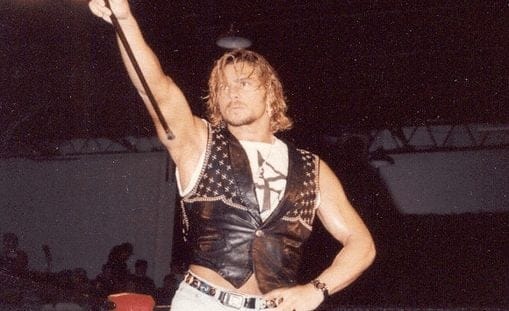
When I was Vice's pro wrestling columnist, I interviewed Hangman Adam Page. As I recollect, it was after his 2018 moonsault at Ring of Honor's Manhattan Mayhem, one of a series of dangerous, highly circulated moonsaults at the time which heralded him as the next big thing.
He was lovely during our interview. Clearly sharp, funny, and engaged. It never ran, because someone died that week and I had to write about that instead. Then a bunch of other stories broke in the weeks after, and the moment of relevance had passed.
Hangman did go onto become the next big thing and is now one of the big current things, not least because he's regarded as the Good Wrestler: he's the right amount of woke, he's still clearly smarter than the median pro wrestler, he's got the right look, says the right things. And I can vouch, even if it was never published.
That's the backdrop for pro wrestling internet blowing up over an Instagram post of Hangman and Marty Scurll outside a Cracker Barrel, captioned "Handsome devils reunited".
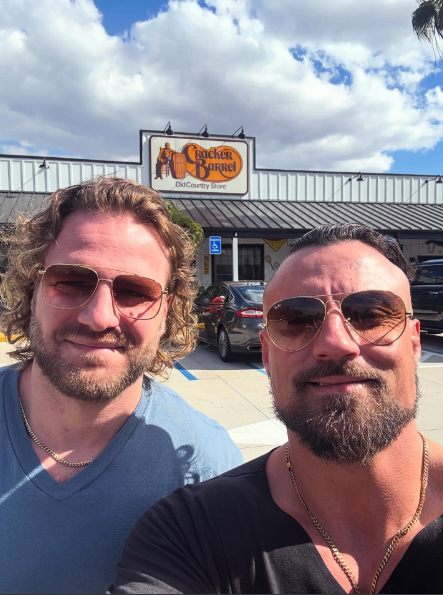
Scurll is a popular wrestler with "the boys". The category "boys" in this instance includes Hangman, Cody Rhodes, the rest of the Elite, and a host of others. Totally good wrestler, more popular than good.
Scurll also has longstanding allegations that he sexually assaulted a drunk 16 year old hanging over him.
I don't want to litigate the allegations, talk about what the correct level of tolerance for art/artist separation is, or whether Hangman is a hypocrite. Instead, I want to offer the direct, simple, and (I feel accurate) thesis that all pro wrestlers are at least comfortable with some level of criminality or are outright criminals. Yes, including your fave (whoever that might be).
This isn't necessarily because of discrete instances like the above. It's because pro wrestling is a century and a half long criminal enterprise masquerading as theater. To be part of it at all is to be willing to tolerate that fact.
When I started grad school, I took an extensive seminar on Foucault my first semester. I wanted to do a little genealogy and discourse analysis of pro wrestling for the final paper. I figured writing about pro wrestling was a prior (meager) career, why not keep riding the wave? So I did, diving into histories of pro wrestling, histories of kayfabe as a language, professional codes within pro wrestling, how the categories of wrestler and mark are constructed.
It wasn't very good and you don't actually want to read it. But it was useful for me for a few reasons. First, the criminality of the whole thing really is pro wrestling's bedrock. Kayfabe is simultaneously professional code and professional language (those are probably the same thing). At best, it's ruthlessly exclusionary: we pro wrestlers are workers, you are not. We are workers because we are professionalized via this code and language, and you are not. You are how we make money, your psyches are what we mine. You can see a residual of this in the endless statements on pro wrestling podcasts about the ways pro wrestlers simply cannot and should not be criticized by people on the outside. Was a match bad? How would you even know, mark, you ever do an 8-ball before doing back-to-backs at the Omni? Didn't think so.
Again and again, from the moment the earliest pro wrestlers were ripping carnival goers off to Hulk Hogan and Vince McMahon covering up a steroid ring while union busting to Brian Pillman screaming at a crowd that they're all marks to Chris Benoit murdering his family to WWE's dalliance with Saudi Arabia... on and on and on, all some shade of criminality, of lying, of grifting, of ripping someone off, of hurting people.
Even now, in the era of wrestling-as-theater, the basic language of success is the cold, hard language of the market: how many butts in seats, what's the gate, that guy sucks but he made us (and the "us" being referenced when wrestlers say this is worth considering) a lot of money, which company makes more money, what are the television ratings, what's the buy rate? Except, as we know now, the market mostly just a variety of scams.
Which is point two. I find pro wrestling studies, such as it is, incredibly annoying. Not wrong, precisely; I assign that Barthes essay in my media studies class. But nowhere will you find an assessment of pro wrestling as a criminal enterprise, let alone anything critical of it as the ruthlessly market-oriented form it is. Pro wrestling studies tends to fall into the theater mode of analysis, focusing on its productive capacity to alter reality through performance: what if we could harness kayfabe for good. Only it never (and look, maybe someone has, I rarely check anymore, but let's say it's at least not prominent) makes the move in describing why or how kayfabe is used for bad. The answer, of course, is that it's used for bad because it is bad, and part of its badness is that it is so compelling. It does speak to our desire for mythic spectacle, something old in our still Bronze Age brains stuck in a silicon era. What else does that?
Unless, of course, we're talking about Donald Trump. And I've written that piece, but that was also in 2017, when we were still reeling from the first blush of our current nightmare. But people are still writing that same piece about Donald Trump as pro wrestler/master of kayfabe ten years later. Did you know Donald Trump is like a pro wrestler? Do you? Did you know that?!?! The link in the previous sentence is from 2025 and is titled "How Professional Wrestling Explains Donald Trump's Washington". Well, I'll be damned, what a novel take.
Again, it's not that it's wrong. It's that it's boring. It's old. And it never makes the drastic, cutting move: what if it's not that Donald Trump is a pro wrestler, or that everything is kayfabe, but that the everything is pro wrestling argument misunderstands the criminality, that if everything is pro wrestling and pro wrestling is criminal then everything is criminal, and that is what got Trump elected. Not that he's toying with reality but that he's giving voice to the reality we insist isn't real. He even said it once, in 2016. Remember? All these rich people pay politicians off, the politicians take the money, and I'm going to do that, too, only I'll tell you I'm doing it.
I just want something more from pro wrestling writing and thinking these days. It feels utterly exhausted. Art, theater, acrobatics, reality, who cares?
A few years ago, a very real feud between Hangman Adam Page and CM Punk spilled its borders and nearly brought down WWE competitor AEW. The lines were immediately drawn: Hangman the virtuous vs Punk the hypocrite. I'm not going to recount all the details for the novice, but the primary faultline for fans was and is that Punk is, well, punk but fake. He also says the right things, but he went back to WWE, worked Saudi Arabia after excoriating WWE for working with Saudi Arabia, and went so far as to sue WWE for unsafe working conditions and negligence.
When Punk left AEW and returned to WWE, the discourse was entirely predictable. First, which company is your favorite? You have to support a brand. The brand is the most important thing. Second, Punk is a poseur.
AEW is light years better than WWE. It's still a criminal enterprise. Punk is a poseur, but Hangman is also a poseur. They're all poseurs. They've always been poseurs. No amount of searching for pro wrestlers' inner cores, the "real" them underneath the characters they play and the things they say, will work. Your fave is a carnie, the same basic person as that strongman in 1898 insisting you, yes you, surely won't get ripped off. You may not know it yet, but someday you will. And you'll go back to the well, trying to figure out which wrester is the good one, the virtuous one, not the one who lines up exactly with your politics but the one who won't countenance the criminality.
You won't find them.
Keep watching. I still do, though I do it a lot less than I used to. Writing obituaries for dead wrestlers and watching the worst show on television (Raw) every week for six years makes you a little numb to the novelty of it all. But be clear-eyed: pro wrestling is the last open air black market, a place for drug pushers, rapists, murderers, and psychopaths of all kinds, built on the bones of the dead, populated by ghosts who are conjured and re-conjured by necromancers.