Book Announcement

I'm happy to announce that I've signed my first book deal with MIT Press for a tentative 2028 release. It considers the miniatures wargames industry as a craft industry, and is based on my dissertation. I've had the deal essentially sealed for the better part of two months, but the contract came in to make it official while I was in the UK, so I had to wait until I returned to properly announce it. It is extremely tentatively to the point of being a placeholder titled Cast and Play. This is a bad title, the editors know this, and anyone who has worked with me knows that I am awful at coming up with titles. I sort of panicked when I was putting the proposal together, because I didn't want to duplicate my dissertation title. It will change, probably something close to my dissertation title (I panicked needlessly).
The research operates on two tracks, one which engages with craft theorization and cultural materialist histories of work, the other a qualitative study in line with existing work in game studies. My hope is that the hybridity works for people and it reaches an audience with multiple interests. Certainly, the project was enough to get my fancy robes, but a dissertation is a fickle thing made for an audience of five (give or take).
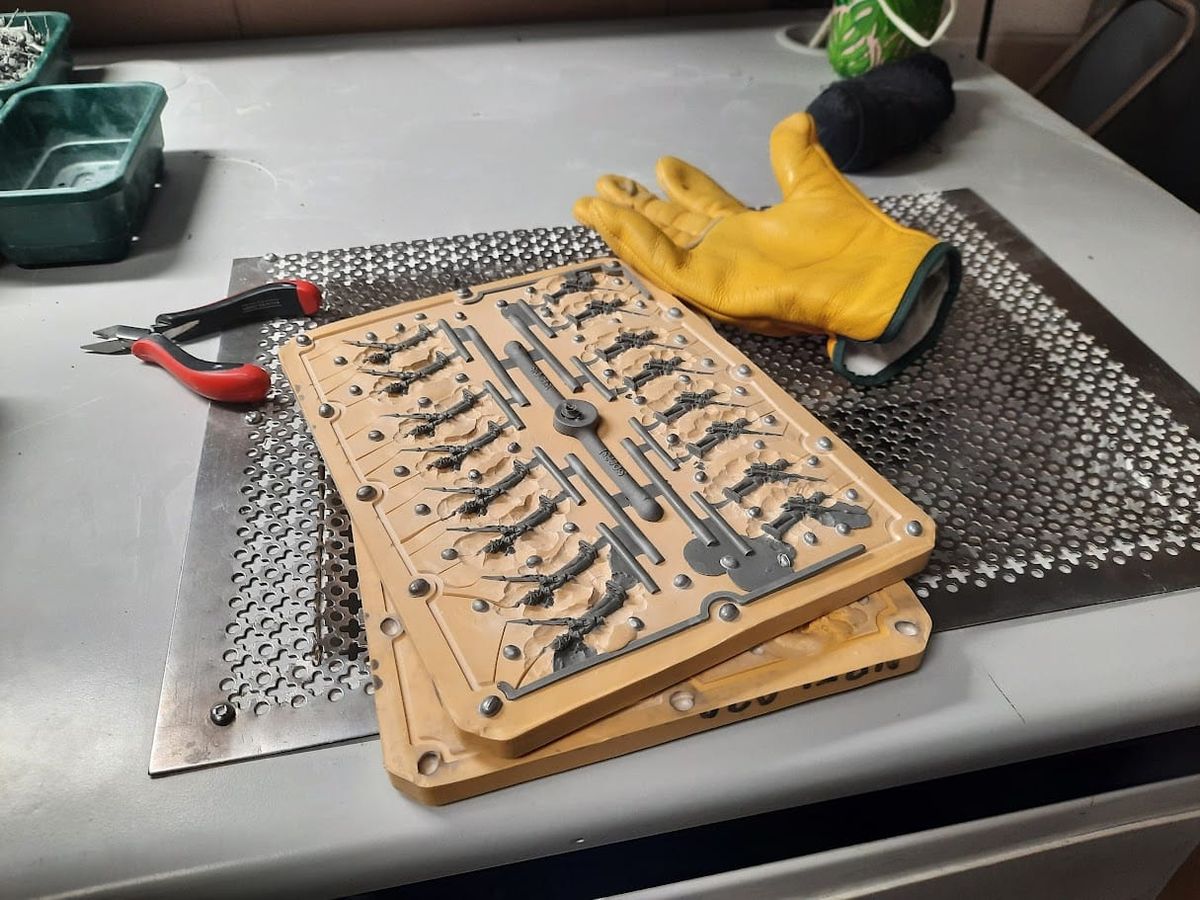
The process in very brief was as follows. I have an interest in meaning-making at work, one which underpinned my popular work during my past life in media. I read a bunch of craft theory, but was never quite comfortable with what I view as hard binaries between craft and industry, digital and analog, tradition and innovation, nostalgia and forward-thinking. So I cast about for an object of study which would complicate those binaries. It turns out I had one near at hand: miniatures. The sector is an odd duck, with craft communities on the sculpting end only seeing their work realized as miniatures once the object is mass produced and shipped out. There are roles like moulders which are explicitly hybrid craft/industrial. And then the truly unique stuff, like the (unconfirmed, because they wouldn't talk to me) story I was told that Games Workshop's sprues aren't made by computer alone but by a single guy who's been there for 30 years and can eyeball a miniature to split it into perfect, easy to ship but not necessarily assemble components. Finally, all of these people work in one complex: people writing in one room, while two rooms over are forges and warehouses.
All of this operates in an almost alchemical milieu: the craft becomes the industrial product and then is reconstituted as craft when you take a miniature home to paint it. The singular becomes many becomes singular. Or, in a cheeky tweak on Marx, it's CMC: Craft - Mass Production - Craft.
The core of the research consists of 26 interviews I conducted in and around Nottingham; you can read the summary report here. All interviews are anonymous save five: Rick Priestley, John Stallard, Ronnie Renton, Chris Peach, and Patrick Taylor. Interviews were primarily conducted at Warlord Games and Mantic Games, and the anonymous interviews were with more vulnerable employees. Their responses as to why they chose this field, why miniatures wargames, and who it's for were often surprising. My hope is that there's much to surprise others, as well.
This is also the story of a place: the Lead Belt. As I put it in my dissertation, and this will make it to the book, Nottingham and its environs are central to the miniatures wargames industry. Place it somewhere else, it's not the same thing as it is now. It is, even as it's expanded globally, an extremely local thing blown up to huge proportions. There's a story in there about a postindustrial city, or rather sections of it, reinventing itself in a time when a lot of places struggle. Nottingham reminds me of the area I grew up: Lexington, Greensboro, High Point, Winston-Salem. Same size, same challenges, same vibes.
This won't be an exhaustive history of miniatures wargames, though it is a history of sorts. I ran into the surprising "problem" of a) my committee knowing nothing about the sector and b) very little academic literature on miniatures (Mikko Merilainen et al, whose work was invaluable, excepted) compared to boardgames and especially tabletop roleplaying games. I found myself having to really think about the basics:
1) If I had to describe a miniatures wargame to someone who had never heard the word, much less played one or even seen one, how would I do it? How would I differentiate it from an old Avalon Hill wargame? You can see an attempt at that here.
2) Why has this been neglected compared to other analog games sectors, especially given that Games Workshop pulls in roughly the same amount of revenue as Wizards of the Coast?
3) Why this? Why is it so British? Why is it so concerned with real world history, even in non-historical games?
4) What does Games Workshop mean? By that I mean to ask why does everyone work at Games Workshop then go on to do their own thing, when most other gaming sectors operate in reverse fashion?
5) How does a community arise out of the crafty stew of the Lead Belt given number 4? And why does everyone like each other so much?
6) Why is it so white and male, and what does that configuration mean for those who aren't? Pursuant to that: what role does the transition from a loose, narrative style of game to the dominance of ruthlessly quantified competitive tournament games play in this?
There are other questions about technology, management techniques, nostalgia, and materiality in there, but you'll have to wait for the book. I am, of course, beyond thrilled to sign the contract but more thrilled at the prospect of you reading (and critiquing) it.