But it was no series of hallucinations
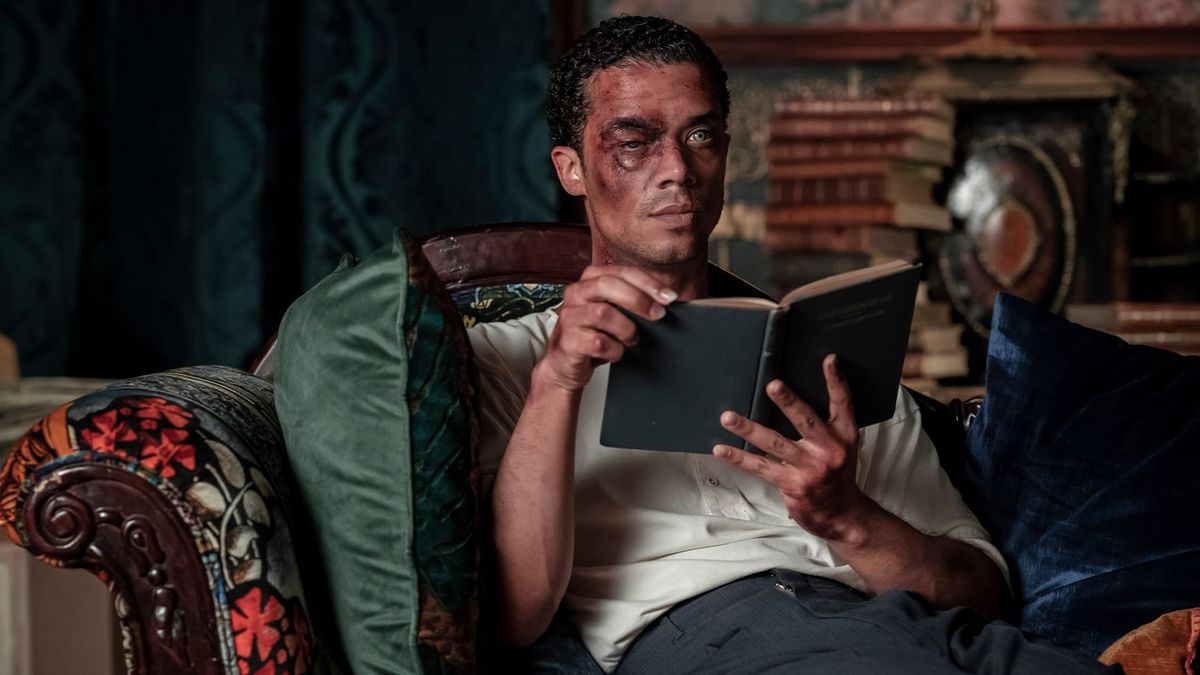
I'd meant to write about Interview with the Vampire (TV version) at least two years ago but kept putting it off. On rewatch two, I'd taken pages of notes, then never did anything with them. Doing a third rewatch, the first with my now old enough kid, and the imminent release of The Vampire Lestat spurred me to finally do it.
I'm most taken by the relationship between media and memory in the show, with a guest appearance by the pandemic. This is not to say that the obvious themes of race and queerness aren't interesting, nor is it to say that others haven't noticed the falsity of memory and unreliable narration in the show, especially as they become the central topic late in season two. Just that my particular interests tend to cohere around themes of memory, time, and nostalgia.
Let me start here: in undergrad, I read a few studies of "flashbulb memory" and its relationship to 9/11. Flashbulb memories are those snapshots of important historical events which cement themselves in your memory; where were you when JFK was assassinated? They're intricately tied to media and only become more so as all events are now realized as and through media. There's a bleed with cultural memory, where the settled version of events become the broadcast version, realized as personal events. I remember (ha!) reading one, which I can't find now (haha!), detailing how study participants had false memories of where they were and what they saw on 9/11. They described news broadcasts and disaster footage as if they were there when they weren't. They weren't lying; they were mistaken.
The point is that you don't remember anything as it really was. There may not even be a "really was". What you think of as memory is impossibly, intricately molded, first, by your social circumstances and, second, by media. We can only remember anything through other people, but their memories are also unreliable. Their memories are also mediatized, just like yours. When you reminesce with your mother about your childhood, what you're actually doing is cobbling together a composite of unreliability. It's the process which is important, not the result, because the result can never be perfect. That this causes a perpetual state of uncertainty and psychic anguish should be a given.
Your memories are also imprinted and reimprinted via the act of "writing" (where writing is a stand-in for media). We arrive here via Freud and Derrida. From Elsaesser's commentary:
The first commentator to suggest that Freud possessed a media theory was Derrida, who discusses ‘A note upon the “mystic writing-pad”’ extensively in his essay ‘Freud and the scene of writing’. Derrida shows how Freud vaccillated between thinking of the psyche as an optical system and as an ‘inscription’ or ‘writing’ system. Visual metaphors predominate in The Interpretation of Dreams, where one finds an entire scenography of telescopes, cameras, microscopes and magnifying glasses. By contrast, once Freud begins to speak of memory, as he does especially in ‘A note upon the “mystic writing-pad”’, the language is one of ‘memory traces’, of the violence with which sensory data break themselves a path (Bahnung) into the mental–material substratum and generally force their way into memory. Derrida notes how the Wunderblock as a child’s toy inscribes marks or grooves on a wax background, and how these are then ‘mystically’ erased by lifting the plastic cover sheet. Memory here clearly recalls the ancient practice of the palimpsest, the writing process whereby mnemic impressions emerge, merge and re(e)merge through acts of layering and superimposition.
Elsaesser also writes about vampires later. I'll return to that. For now, let's just take as given that vampires in their human guises, or perhaps with their rump humanity intact, are no different than anyone else.
The key figure in Interview with the Vampire isn't Louis, Claudia, or Lestat, even if they're the most compelling. It's Daniel Malloy, the journalist who conducts the titular interview. He is necessary for Louis to remember. Louis can only remember events "accurately" through speaking to Daniel, a version of Freud's talking cure. Except Daniel isn't a friend or family member. He's a reporter. He's media. And he's surrounded by the technological accoutrements of that fact: first tape recorders and pencils, later a laptop, earbuds, and digital recording equipment.
This isn't the only time Louis is interviewed. In season two, Louis and Claudia meet a British reporter on the Eastern Front during or just after (memory) WWII. The reporter immediately begins to interview Louis, an out of place American in Romania, about why he's there. Is he a Bolshevik? That would be fine, except Bolsheviks in the West lie. And Louis lies. He drinks vodka he cannot get drunk off of, pretending to be drunk, lying about his photo of his sister being a photo of his wife (is Claudia also his sister-wife?). He's so convincing, so convivial, as he lies that the viewer is tempted to believe him. If we forget everything we know, we believe him, too.
The casting of Eric Bogosian as Daniel seems portentous. Bogosian has sort of always been around, a lingering reminder of a particular late 70s New York cool, never an A-list star, more important than super famous, but then nobody who was cool was. And he's playing himself in Interview. He's just Eric Bogosian. In an interview, he claims he was inspired by Lou Reed for the role, but also he was inspired by Lou Reed for his role as Eric Bogosian. Bogosian gets annoyed when people point out his portrayal of Daniel resembles Anthony Bourdain. Both he and Bourdain borrowed from Reed, he retorts, and besides, Talk Radio released 12 years before Bourdain showed up.
Given the centrality of eating adventurous meals then commenting on them to Bogosian's portrayal of Daniel, that feels like the gentleman protesting too much. But how do you know? How does he? All we are are characters. Media . Who's the real Eric Bogosian? Who's the real Anthony Bourdain or Lou Reed? Whether wittingly or not—and I tend to think it's quite a bit more the former, given how closely the show's portrayal of Daniel resembles Richard Morris in Perforated Heart—Bogosian playing Daniel as Bogosian (who is Richard Morris who is Lou Reed who is Anthony Bourdain who is Eric Bogosian) both grounds the show in a real world, long term presence while calling into question what and who that presence even is.
Which is in keeping with the theme of the show. Who are any of us? You don't remember. What you do remember isn't a static base of you-ness, it's motifs and movements. Louis remembering jazz, Lestat remembering opera. Sartre and Jelly Roll Morton make fleeting appearances in the show before disappearing. Media can tell a truth. Louis speaks to Daniel because Daniel is the only one who still believes it (and Daniel says as much). A younger Daniel, per the novel, wouldn't work in the television series: what current 23 year old believes the media can tell the truth except in its capacity to insist that everything is at least a little true? Bogosian as Daniel is the last modernist, both in the character's writing and in his position as a 70 year old real life Renaissance man. The last one who thinks you could reassemble all these fractured things at all.
Dubai is another major character in Interview. The pat, not incorrect answer to why it's set in Dubai is that it's the ultimate capitalist city and vampires, as metaphors for capitalism, fit right in. Not incorrect, but it's more accurate to say that Dubai is the ultimate postmodern city. It doesn't exist as a global hub of much of anything, much less finance and culture (heavy skepticism on the last), prior to the acceleration of neoliberal postmodern fracture in the 1990s. It's where the rich and powerful go to reassemble and/or create meaning in the 2020s. It's a place but also no-place. Armand says that Dubai is a child, no one is native to it. And, not for nothing, the formal presentation of Louis and Armand's penthouse, stuffed with Francis Bacon paintings and food from everywhere, both shorn from their situated contexts of place, reminded me of the Ark of the Arts scene in Children of Men. Art as pure commodity: Louis and Armand sell Bacon's Figures at the Base of a Crucifixion, Nigel sits next to Guernica and David while his son refuses to talk to him.
Talking. Media. Those are the things that force vampires to remember. Remembering hurts, both them and us. The most terrifying scenes in Interview aren't gory. They're when the vampires either remember or force us to remember. In season two's fulcrum episode, Armand forces the young Daniel to remember the petty horribleness of his adolescence, the cruel sex and casual peddling of his dad's Playboys. Lestat forces a mortal at the Theatre des Vampires to experience his memories of vampiric loneliness; upon being heckled by a homophobic GI in the balcony, Lestat enter's the GI's mind to reveal his cowardice on the front lines. Louis, of course, finally remembers that he was a monster, not for his unlife of murder but for his psychological abuse and manipulation of Lestat, in that Dubai penthouse.
But the first thing that Daniel remembers about 1973 is the television. A sock commercial. Spiro Agnew's resignation. Events. Flashbulbs. Then, the rest. Lestat does his mind magic during a theatrical performance which is also real (what's real?). Louis only remembers in conversation with Daniel as anthromophization of a particular idea of media, and only realizes Armand lied to him about the events at the Theatre des Vampires when he reads margin notes in a playscript. It's not just memory or just conversation or just media, but all three reliant on one another, entangled so much that they're indistinguishable.
Elsaesser again:
Since, there is no need to highlight the abiding affinity of cinema with the Dracula figure as the archetypal embodiment of the uncanny undeadness and inbetweenness of cinematic life and its preservation, reanimation or storage, I want to draw attention to Kittler’s take on Dracula, Bram Stoker’s 1897 novel, rather than, say, F.W. Murnau’s film Nosferatu (1921). Kittler reads the novel as a commentary on the media origins of psychoanalysis at just about the same time as its principles and first therapeutic practices were being formulated by Freud. For Kittler, Dracula is a creature driven not by desire but by some other force and energy: that of a technical media revolution, as it has impacted the domains of information and communication. As such, the Count may be the only original and authentic myth that the age of mechanical reproduction has produced; so that Dracula stands for the eternal repetition of mechanical inscription (die endlose Wiederholung durch automatische Aufzeichnung) which has entered the western world with the typewriter, the gramophone/phonograph and the cinema.
He continues:
In Kittler’s scheme of things, technological media and psychoanalysis thus compete for literature’s legacy, trying to take on the various information processing tasks and cultural memory mandates that used to be literature’s monopoly: the recording, storing, repeating of experience, in sounds and images, text and traces, embodied or imagined, manifest as physical symptoms or as phantom sensations. Where film and cinema (or the audiovisual media generally) accomplish such recording by mechanical means and on synthetic material supports, psychoanalysis has retained the body and the voice as its ‘natural’ material support. Yet it, too, tries to ‘automate’ the recording process as much as possible through free association and the seemingly esoteric, but strictly controlled, body of techniques that make up ‘analysis’.
The vampire as a myth is wedded to technology. As characters, the vampires of Interview remember only through encounters with technology. No wonder the story told in the 1973 flashback necessarily entails different memories than the modern day story told in Dubai. The recording media Daniel used in 1973 was different, the stories are different, they (and we) are/were different. All we are are memories.
Do you remember vampires before Anne Rice? The dorky Hammer Films Dracula? Rice's work is decidedly postmodern, but in a specifically at the cusp of fracture sort of way. Like Daniel, she works to reassemble meaning but still insists there is some meaning; she hasn't fully thrown in the towel. But she wrote at the advent of the digital, and this means her vampires cannot be Dracula, because vampires are irreducibly connected to technology.
From Catherine Belsey's "Postmodern Love: Questioning the Metaphysics of Desire":
Rice’s vampires draw on what is presented as an infinite regress of textuality: novels and films and, before them, legends, mythology. But they are also redrawn as postmodern figures, inhabiting a global present which includes extremes of deprivation and poverty on the one hand and a paradise of consumer pleasures on the other. They can fly, but they also travel in airplanes and own fast cars. They practice telepathy and watch television.
They are accomplished, elegant, sophisticated—and driven. Though they have ancient roots, vampires come to prominence in Western culture toward the end of the seventeenth century, at the moment of the Enlightenment.” Associated primarily with Eastern Europe, that strange territory familiar from travelers’ tales, but seen as just beyond the reach of the new knowledges being produced in the West, vampires initially hover uncertainly between the realms of fact and fiction. These mysterious, alien figures haunt a culture which is busy ridding itself internally of superstition and irrationality. Vampires emerge from the East to fascinate the enlightened West.
She continues:
In Freudian terms, for vampires the imperatives of sex and survival are
reunited, by prizing apart desire and love. In Lacanian terms, need and
demand are explicitly separated, so that Lacan’s gap becomes a chasm.
Vampires are compelled to seek a prohibited pleasure outside the Law
that they cannot repudiate. Desire is not repressed, but a perpetual,
conscious condition, and it is above all the desire to regain humanity, for
all its limitations and contradictions. The vampire Lestat is, he tells us,
“an anguished and hungry being who both loves and detests this
invincible immortal shell in which I'm locked” (3-4). “To be human,
that’s what most of us long for. It is the human which has become myth
to us” (528). But ironically, when in The Tale of the Body Thief (1992)
Lestat regains a human body, he cannot bear its organic inadequacies.
Meanwhile, the human figures in the stories long to be immortal. Desire
is thus seen to be forever unfulfilled.
A textual fiction, portrayed as beyond the alternatives of life and death, love and hate, good and evil, Anne Rice’s vampire is surely the type of the postmodern lover: at once skeptical and idealizing, and therefore restless, unsatisfied, dis-placed and, in the last analysis, solitary.
Finally, closing with a bit about Coppola's version of Dracula:
And that, perhaps, is the key to the postmodernity of this text: it insists
on its own fictionality. It therefore feeds our longing for ideal love, our
hunger for metaphysics, while at the same time taking account of our
skepticism, our incredulity toward romance. Simultaneously sophisticated
and naive, the film gives us both what we know and its converse,
what we desire, in a single expensive and beautiful package. You can
have it all, if only at the cinema.
If part of the appeal of the vampire myth is that there is a constant, solid past from which they arise, which is the real vampire? Does it matter? But, for the purposes of this, do you remember them? Is Dracula scary? From Rice descends the entirety of modern vampire media: Lost Boys, Vampire: the Masquerade, True Blood, Only Lovers Left Alive, and the greatest vampire film of all, Let the Right One In. Where the vampire is representative of a constant past brought into postmodernity, it's only ever for laughs; this is the entire conceit of What We Do in the Shadows.
What do you remember about the pandemic? I mostly remember long stretches of nothing. Shows. Sitting in front of my computer. The dull regret of not walking with my master's degree and instead sitting at the same computer on Zoom while names were called out. Not for nothing, when I got my doctorate I insisted that I do every event and made everyone come to them to make up for it. I needed to make memories.
My kid sort of broke then, like a lot of kids. Safety was, of course, the overriding concern, but I saw her grow lonely, at that perfectly imperfect 7th grade age, custom made for maximum impact from the pandemic's grand severing of our sociality. She and her cohort are still recovering.
Those years are a void. They feel a lot like Lestat's monologue on vampiric loneliness sounds. This is a pandemic show and vampires are, amongst other things, metaphors for disease. Humming in Interview's background are whispered worries about the Great Conversion, when humans will be mass embraced. Will those new vampires feel the loneliness, too? Presumably yes, or they will eventually. But, then, we all felt it as we got sick in the real world. The vampires are the pandemic.
This motif is not going to go away in The Vampire Lestat. If anything, it will only intensify, at least if it hews to the novel in any way. The entire conceit is that Lestat writes his own book to counter Louis'. If Louis could only remember, and by remembering write a new Louis, via that great modernist technology of the novel/memoir, then that's what Lestat has to do, too. If Louis can reveal his true nature by speaking through air, his great gift, then Lestat can do the same through music, his great gift.
Certainly, Lestat will be aware of his inbetweenness in postmodernity. Snippets from the early bits of the novel, passed to me by a thinking partner who had it handy:
What brought me up were two things.
First—the information I was receiving from amplified voices that had begun their cacophony in the air around the time I lay down to sleep.
I’m referring here to the voices of radios, of course, and phonographs and later television machines. I heard the radios in the cars that passed in the streets of the old Garden District near the place where I lay. I heard the phonographs and TVs from the houses that surrounded mine...
...In the art and entertainment worlds all prior centuries were being “recycled.” Musicians performed Mozart as well as jazz and rock music; people went to see Shakespeare one night and a new French film the next.
In giant fluorescent-lighted emporiums you could buy tapes of medieval madrigals and play them on your car stereo as you drove ninety miles an hour down the freeway. In the bookstores Renaissance poetry sold side by side with the novels of Dickens or Ernest Hemingway. Sex manuals lay on the same tables with the Egyptian Book of the Dead.
It's all Jamesonian. Very demure, very pastiche. To reassemble anything from this would be to insist that it can only be reassembled on one's own terms. And here, again, media: music, stereos, airwaves, television, novels, sex manuals, sacred texts. All of them interchangeable for the purposes of assembling a new You/I/Me. Media is so powerful that it can raise the dead. We're all vampires, we're all Daniel, we're all Bogosian/Reed/Bourdain/Bogosian.
Concrete Blonde's song Bloodletting is clearly inspired by Anne Rice's work. On Genius, there's a curious entry next to the following lines:
We used to dance in the garden
In the middle of the night
Dancing out in the garden
In the middle of the night
The annotation reads:
The liner notes state that these lyrics are “They were as naked as the day they were born, skin all bone-china white.” There are no recorded versions of the song that use this line.